
AI in Healthcare Diagnostics: Beyond the Hype
You’ve probably heard about AI in medical imaging and how it could change healthcare diagnostics. But what does this mean for you? How can it make your healthcare better?
The paper titled “Beyond Big Data to New Biomedical and Health Data Science” highlights the major impact AI can have on medical diagnosis. It says AI can make healthcare better by using smart algorithms and machine learning. It supports faster, more reliable decisions in areas such as medical imaging and patient triage.

This isn’t just about new tech; it’s about changing healthcare. By looking past the excitement, we see AI’s true power to help patients.
Table of Contents
Understanding AI in Healthcare Diagnostics
AI is changing healthcare, and its effect on diagnostics is huge. It’s key to know the basics of AI in healthcare and the tech behind it.
What is AI in Healthcare?
AI in healthcare uses complex algorithms and machine learning to analyze medical data. It looks for patterns and makes predictions or decisions. As a result, clinicians can identify illnesses more quickly and with greater precision.
Defining AI in healthcare isn’t straightforward because it sits at the intersection of computing, clinical practice, and statistical methods. Sensitivity and specificity are important for AI diagnostics. They show how accurate tests are. Also, external validation is needed to make sure AI works well for all patients and in different settings.
Key Technologies Driving AI
Several technologies are pushing AI in healthcare diagnostics forward. Machine learning algorithms let systems learn from data and get better over time. Natural language processing (NLP) is also key. It helps AI systems understand and analyze large amounts of clinical text.
AI in diagnostics works best when humans and AI systems work together. This is called clinician-in-the-loop. It ensures that diagnostic decisions are accurate and reliable.
Historical Context of AI in Healthcare
The journey of AI in healthcare has been long and filled with important milestones. It shows how AI in medical diagnostics has grown and improved over time.
Early Innovations in Medical Diagnostics
The start of AI in healthcare diagnostics was marked by early innovations. These innovations set the stage for today’s technologies. One key development was the creation of computer aided detection (CAD) systems in radiology.
These systems helped radiologists spot abnormalities in medical images. They were a big step forward.
Key early innovations include:
- Development of rule based expert systems to support clinical decision making.
- Introduction of machine learning algorithms to analyze medical data.
- Early applications of neural networks in image analysis.
Milestones in AI Development
The journey of AI in healthcare has seen many important milestones. These include better machine learning algorithms, AI with electronic health records (EHRs), and natural language processing (NLP) for clinical documentation.
A major milestone was when the FDA approved AI-powered diagnostic tools. For example, the FDA cleared AI algorithms for detecting diabetic retinopathy and certain cancers. These approvals helped AI become more accepted in clinics, making sure it follows FDA/CE pathways for safety and effectiveness.
| Year | Milestone | Impact |
|---|---|---|
| 1990s | Introduction of CAD systems | Assisted radiologists in detecting abnormalities |
| 2010s | Advancements in machine learning | Improved analysis of complex medical data |
| 2020s | FDA clearance of AI diagnostic tools | Enhanced workflow integration in clinical settings |
The history of AI in healthcare diagnostics shows a path of ongoing improvement and innovation. As AI keeps evolving, it will become even more integrated into healthcare. This will lead to better diagnostics and care for patients.
Current Applications of AI in Diagnostics
AI in diagnostics has seen big steps forward in image analysis, predictive analytics, and natural language processing. You’ll see AI in many healthcare areas, like analyzing medical images and predicting patient outcomes.
Image Analysis and Radiology
AI algorithms are now used in medical imaging to help radiologists find and diagnose problems better. For example, Ferrum Health uses AI to make medical image analysis faster and more accurate.
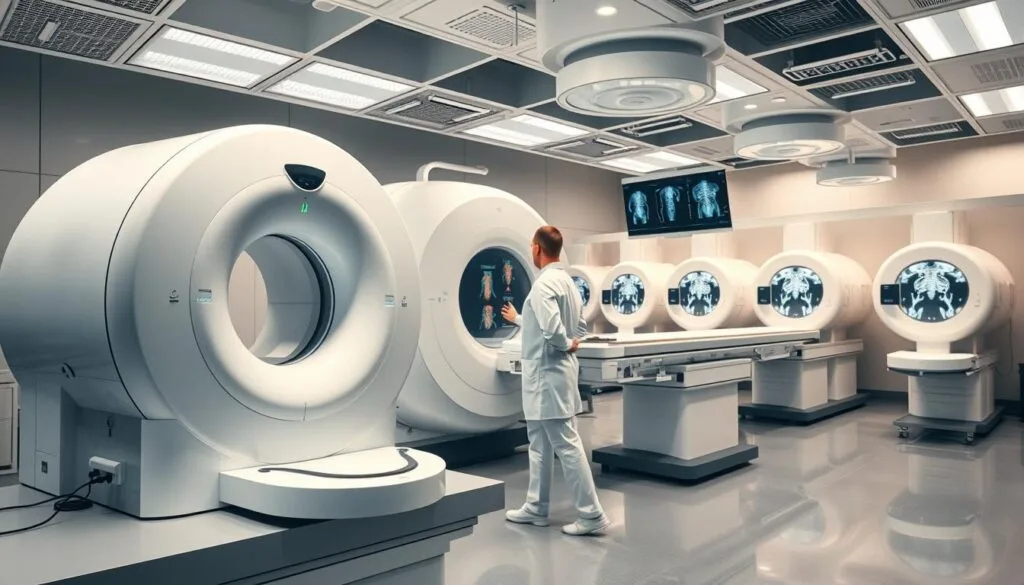
AI in image analysis does more than just detect issues. It also helps sort cases for radiologists, a process called triage. This means urgent cases get seen first, which can save lives.
| Application | Description | Benefit |
|---|---|---|
| Image Analysis | AI algorithms analyze medical images to detect abnormalities. | Improved accuracy and speed in diagnosis. |
| Triage | AI prioritizes cases for radiologists based on urgency. | Ensures critical cases are addressed promptly. |
| Regulatory Compliance | Adherence to standards like ISO 13485 for medical devices. | Ensures safety and effectiveness of AI diagnostic tools. |
Predictive Analytics in Patient Care
Predictive analytics is a big area where AI is making a difference. AI looks at patient data to predict outcomes, helping healthcare providers act early.
AI will play a bigger role in patient care, making treatment plans more personal and improving results.
Natural Language Processing in Records
Natural Language Processing (NLP) is used to understand and analyze clinical records. It helps find important information, easing the workload for healthcare staff.
NLP in clinical records will make workflows smoother. It will make it easier for healthcare providers to use patient information.
Benefits of AI in Healthcare Diagnostics
AI is changing healthcare diagnostics in big ways. It makes diagnoses more accurate and faster. AI looks at lots of medical data, like images and patient histories, to find patterns humans might miss. This makes diagnoses better and quicker, helping patients get the care they need sooner.
Improved Accuracy and Speed
AI can quickly and accurately analyze complex medical data. It uses machine learning to spot patterns humans might overlook. This leads to more accurate diagnoses. AI also works fast, helping doctors make quick decisions that improve patient care.
For example, AI can look at medical images to find things like tumors early. This means doctors can start treatment sooner.
Cost Efficiency in Diagnosis
AI in diagnostics also saves money. It automates tasks, freeing up doctors to focus on more important things. This cuts down on costs. Plus, AI can spot problems early, avoiding expensive treatments later on.
This makes healthcare more affordable for more people.
Enhanced Patient Experience
AI is also making patient care better. It makes diagnosis faster, reducing wait times. Doctors can then spend more time with patients, improving care.
AI can also tailor treatment plans to each patient. The outcome is improved treatment quality and higher patient satisfaction. It’s important to make sure AI helps all patients equally.
It’s key to test AI tools to make sure they work well for everyone. This way, doctors can trust the results, leading to better health outcomes for patients.
Challenges Facing AI Adoption
For AI to reach its full health care diagnostic power, we must tackle its adoption challenges. Key hurdles include data privacy, system integration, and trust and transparency. These are essential for AI’s success in health care.
Data Privacy and Security Concerns
AI in health care deals with sensitive patient data, raising big privacy and security worries. It’s vital to follow rules like HIPAA in the U.S. and GDPR in Europe. AI systems must have strong security to protect patient data, not just for legal reasons but to keep patient trust.
Think about the risks of data breaches and how to avoid them. Use end-to-end encryption, secure storage, and regular audits to keep data safe.
| Data Protection Measure | Description | Benefit |
|---|---|---|
| End-to-End Encryption | Ensures data is encrypted from the point of collection to storage | Protects against unauthorized data access |
| Secure Data Storage | Utilizes secure servers and databases | Prevents data breaches |
| Regular Security Audits | Identifies vulnerabilities in the system | Enhances overall security posture |
Integration with Existing Systems
Integrating AI diagnostic tools with current health care systems is a big challenge. Workflow integration is key for smooth AI adoption. AI systems must work well with electronic health records (EHRs) and other IT systems.
Having a clinician-in-the-loop approach is vital. This means health care professionals should work with AI in decision-making. It boosts diagnosis accuracy and builds trust among providers.
Trust and Transparency Issues
Building trust in AI diagnostics is critical for their adoption. We need to be open about how AI algorithms work and their limits. The lack of explainability in some AI models can make clinicians hesitant.
Work is being done to make AI more transparent and explainable. This includes developing AI that shows how it makes decisions. Such transparency is key to gaining trust from both providers and patients.
Ethical Considerations in AI Diagnostics
Ethical issues in AI diagnostics are key to safe and fair tech use. As AI grows in healthcare, we must tackle its ethical sides. This ensures equity and safety in patient care.

Bias and Fairness in Algorithms
Bias in AI algorithms is a big worry. Bias may originate from the datasets used to train these systems. If the data isn’t diverse, AI might not work well for all patients. Making sure AI is fair means looking closely at the data and algorithms.
To fight bias, developers can take a few steps:
- Use diverse data for training.
- Check AI for bias often.
- Listen to feedback from doctors and patients.
Accountability for Diagnostic Errors
Another big issue is who’s accountable for AI errors. It’s important to have ways to fix mistakes and stop them from happening again. This means making technical changes and setting clear rules for clinician-in-the-loop checks.
Here’s what we need for accountability in AI diagnostics:
| Aspect | Description | Action Required |
|---|---|---|
| Error Reporting | Ways to report diagnostic errors. | Set up a strong error reporting system. |
| Clinician Oversight | Make sure doctors are part of AI decisions. | Create rules for doctor oversight. |
| Continuous Learning | Update AI with feedback and new data. | Keep updating AI algorithms. |
By tackling these ethical issues, we can make sure AI diagnostics help all patients fairly and safely. It’s a big job that needs work from developers, doctors, and regulators.
Future Trends in AI and Healthcare
AI is changing healthcare diagnostics in big ways. As tech gets better, healthcare will improve a lot.
AI in healthcare is more than just making things better. It’s changing how we care for patients. Personalized medicine is a big area where AI is making a big difference.
Personalized Medicine and AI
AI can look at lots of data to make treatment plans just for you. It uses your genes, medical history, and lifestyle to make treatments that work better and have fewer side effects.
AI in medical imaging is key for personalized medicine. AI can spot things in images that humans can’t, helping catch problems early.
| Benefits of AI in Personalized Medicine | Description |
|---|---|
| Tailored Treatment Plans | AI analyzes data to create personalized treatment plans based on individual patient profiles. |
| Enhanced Diagnostic Accuracy | AI improves diagnostic accuracy by analyzing medical images and identifying patterns. |
| Predictive Analytics | AI’s predictive capabilities help in forecasting patient outcomes and adjusting treatment plans. |
AI’s Role in Preventative Care
AI is also big in preventative care. It looks at data to find people at risk of health problems, so we can act early.
AI in triage is another big step. It helps decide who needs care first, so urgent cases get help fast.
As AI gets better, its role in checking healthcare data will grow. This means making sure AI’s insights are right, so we can trust them.
By using these new AI tools, healthcare will become more tailored, early, and effective.
Case Studies of AI Successes
AI has made big strides in healthcare, helping with early cancer and heart disease detection. These breakthroughs are real and are being used to help patients.
Oncology Diagnostics
AI has greatly improved cancer detection, like finding breast cancer early. It looks at mammography images to spot cancer signs. The approach achieves strong performance, marked by high sensitivity and specificity.
Medical experts have designed an artificial intelligence algorithm that recognizes breast cancer through mammography analysis, recording 97.4% sensitivity and 96.8% specificity. This tool helps doctors by giving a second opinion, making diagnoses more accurate.
Cardiovascular Disease Detection
AI is also helping with heart disease detection. It looks at echocardiograms and ECGs to find heart disease signs. AI can quickly and accurately analyze lots of data, leading to early detection and treatment.
A study showed an AI system that predicts heart attacks and strokes by analyzing ECGs. It was very accurate, showing AI’s power in heart disease detection.
| Disease | AI Application | Diagnostic Metric |
|---|---|---|
| Breast Cancer | Mammography Analysis | Sensitivity: 97.4%, Specificity: 96.8% |
| Cardiovascular Disease | ECG Analysis | Accuracy: 95% |
These examples show AI’s big role in improving healthcare diagnostics. As AI gets better, we’ll see more ways it can help patients, leading to better health outcomes.
Collaborations Between Tech and Healthcare
In the fast-growing field of AI in healthcare, tech and healthcare teams are teaming up. This is leading to better and more integrated healthcare solutions. Tech companies and medical groups are working together to make healthcare better.
Partnerships Driving Innovation
Partnerships between tech and healthcare are key for AI in diagnostics. They share knowledge, data, and resources. This leads to better and faster diagnostic tools.
For example, tech companies use AI and machine learning. Healthcare providers share their clinical insights and workflows. This helps make AI solutions better fit into current healthcare.
Workflow integration is where these partnerships really shine. Tech and healthcare teams work together. This makes AI solutions work well with current healthcare practices. It also helps doctors make more accurate diagnoses.
| Partnership Type | Benefits | Examples |
|---|---|---|
| Tech Company + Healthcare Provider | Improved diagnostic accuracy, Enhanced workflow integration | Google Health partnering with healthcare systems for AI diagnostics |
| Startup + Established Company | Innovation, Resource sharing, Accelerated development | Startups collaborating with pharmaceutical companies for AI-driven research |
The Role of Startups and Established Companies
Startups and big companies both play big roles in AI in healthcare. Startups bring new ideas and speed. Big companies offer the resources and know-how to make these ideas real.
It’s also important to make sure everyone has access to these new tools. This way, healthcare can be fair for everyone. This helps make healthcare better for all.
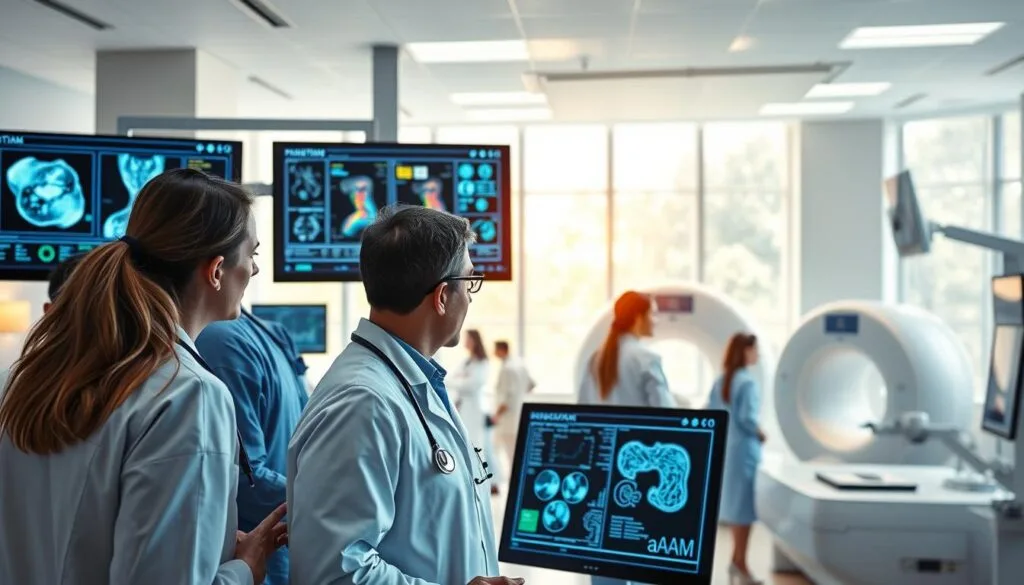
Looking ahead, tech and healthcare working together will keep improving AI in diagnostics. These partnerships will help us make new solutions faster. These solutions will help patients and change healthcare for the better.
The Role of Regulatory Bodies
AI is changing healthcare diagnostics a lot. Regulatory bodies are key in making sure everything is safety and works well. They watch over AI in healthcare to protect patient data and make sure tools are accurate.
Groups like the FDA set rules for AI in healthcare. These rules help make sure AI systems are safe and work as they should.
FDA Guidelines for AI in Healthcare
The FDA has made rules for AI diagnostic tools. These rules cover things like data quality and how AI makes decisions. For example, AI must be trained on many different data sets to avoid bias.
Keeping up with AI’s fast changes is hard for regulators. They need to update their rules often to stay effective.
| Regulatory Aspect | Description | Importance |
|---|---|---|
| FDA Approval | Ensures AI diagnostic tools meet safety and efficacy standards | High |
| Data Privacy | Compliance with HIPAA/GDPR to protect patient data | High |
| Algorithmic Transparency | Understanding how AI algorithms make decisions | Medium |
The Importance of Compliance
Following rules is not just legal; it builds trust in AI tools. Healthcare providers and patients need to trust that AI is safe and fair.
To follow rules, healthcare places must protect data well and be open about AI decisions. They also need to keep an eye on AI’s performance. This helps reduce risks and better care for patients.
Building Trust in AI Diagnostics
Building trust in AI diagnostics is a complex task. It requires educating healthcare providers and engaging patients in meaningful talks. As AI becomes more important in healthcare, it’s key that everyone understands and trusts these technologies.
Educating Healthcare Providers
Healthcare providers play a big role in using AI diagnostics well. They need to know what AI can and can’t do, and its possible biases. We can teach them through workshops, online courses, and research projects.
By making sure providers are involved in AI development, we can build trust. This approach ensures AI is useful and relevant in clinical settings.
Engaging Patients in AI Conversations
It’s also vital to talk to patients about AI diagnostics. They should know how AI is used in their care, its benefits, and risks. Being open about AI’s role helps build trust.
Talking about equity and fairness in AI is also key. This helps ensure AI works well for all patients, not just some.
To show why transparency and equity matter, here’s a table with strategies for building trust in AI diagnostics:
| Strategy | Description | Benefit |
|---|---|---|
| Clear Communication | Explain AI’s role in diagnostics clearly to patients and providers. | Enhances understanding and trust. |
| Education and Training | Provide ongoing education for healthcare providers on AI capabilities and limitations. | Improves effective use of AI diagnostics. |
| Transparency about AI Development | Share information about how AI algorithms are developed and validated. | Fosters transparency and trust in AI systems. |
By using these strategies, we can make AI diagnostics trusted by both providers and patients. This journey is ongoing but worth it for better patient care and healthcare efficiency.
Conclusion: The Future of AI in Healthcare
AI is changing healthcare diagnostics in big ways. It’s making medical imaging and patient care better. This technology is not just a trend. It’s a big step towards safer and more accurate medical diagnoses.
Innovation for Better Outcomes
Using AI in healthcare can lead to better patient results. It makes diagnoses faster and more accurate. AI can look at complex medical images, helping doctors find health problems early. This improves care and safety for patients.
Ongoing Journey in AI Diagnostics
The use of AI in healthcare diagnostics is always growing. New technologies like medical imaging analysis are coming. It’s important for healthcare providers to keep up with these changes. This ensures AI is used safely and effectively in healthcare.